Indoor Exercise Bike Buying Guide: Flywheel Weight, Resistance Types, and Spin vs Recumbent
- Published on
Indoor Exercise Bike Buying Guide: Flywheel Weight, Resistance Types, and Spin vs Recumbent
The exercise bike market ranges from $200 entry-level machines that wobble and squeak to $2,500 professional spin bikes with power meters and connectivity. The factors that determine whether a bike delivers a satisfying workout — and whether you keep using it — have little to do with the feature list and everything to do with mechanical quality.
The Three Types of Indoor Bikes
Upright / Spin Bike
Most similar to outdoor road cycling. Forward-leaning position, small seat, pedals directly below or slightly forward of the body.
Best for: HIIT workouts, cadence training, cycling-specific fitness, calorie-intensive sessions. High intensity ceiling — you can sprint, stand, and push hard.
Not ideal for: Long steady-state sessions without saddle discomfort; back problems; beginners uncomfortable with forward-lean position.
Recumbent Bike
Seat is placed back and low, with a backrest. Pedals are in front of the body at roughly hip height.
Best for: Low-impact recovery, rehabilitation, back/joint issues, older adults, long moderate-intensity sessions. Comfortable for 45–90 minute rides.
Not ideal for: High-intensity intervals; calorie efficiency is lower than upright for same effort; requires more floor space.
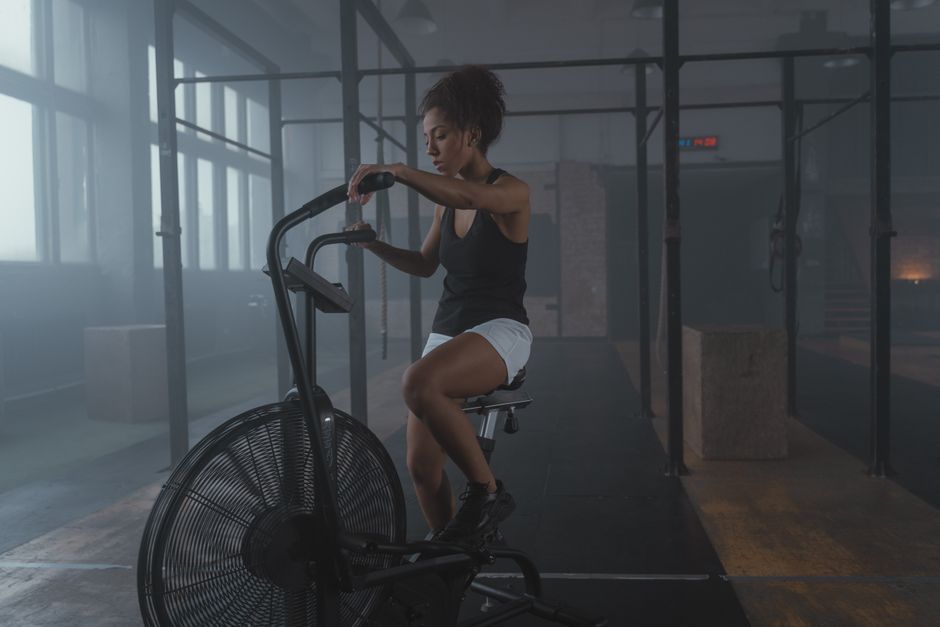
Air Bike (Fan Bike)
Resistance comes from wind resistance generated by pedaling — the faster you pedal, the harder it gets. Arms move simultaneously with legs.
Best for: Interval training, full-body cardio, military fitness testing. Essentially unlimited resistance ceiling.
Not ideal for: Quiet environments; the fan is very loud; not suitable for steady-state comfort training.
Flywheel: The Most Important Mechanical Spec
The flywheel stores rotational kinetic energy, smoothing out the dead spots in the pedal stroke and creating the "momentum" sensation that characterizes good cycling.
Weight and Momentum
A heavier flywheel creates more inertia — the wheel continues spinning with momentum even during the power-off portion of the pedal stroke. This produces:
- Smoother pedal feel
- More realistic road-cycling sensation
- Less knee stress (no dead spots causing impact)
Flywheel weight categories:
| Weight | Feel | Best for |
|---|---|---|
| Under 10 kg | Noticeably choppy, toy-like feel | Budget entry; short use sessions |
| 10–15 kg | Acceptable smoothness | Casual use, beginners |
| 15–20 kg | Good momentum, satisfying feel | Regular training, intermediate |
| 20+ kg | Excellent road-like feel | Serious training, enthusiasts |
The heavier-is-always-better caveat: Very heavy flywheels on direct-drive trainers (20+ kg) can be harder to start from a stop and require more careful maintenance. For most home users, 15–18 kg is the sweet spot.
Resistance Mechanisms
Friction (Felt Pad) Resistance
A physical felt or rubber pad presses against the flywheel.
Characteristics:
- Very low cost
- Infinite resistance adjustment (turn a knob)
- Pad wears out over time — replacement required
- Pad pressing on flywheel generates heat and debris
- Typically louder
- No accurate resistance measurement possible
Verdict: Acceptable for casual low-budget use. Not suitable for serious training.
Magnetic Resistance (Fixed Distance)
A magnet creates an electromagnetic braking force on the flywheel without physical contact.
Characteristics:
- Silent operation (no friction, no noise)
- No wear parts — indefinite lifespan
- Resistance adjustable in discrete steps (typically 8–32 levels)
- More expensive than friction
- Cannot produce true watt measurement without additional sensors
Verdict: The standard for quality home bikes. Preferred for apartment use and early morning sessions.
Direct Drive / Electromagnetic (Smart Bikes)
A servo motor or electromagnetic brake provides dynamically controlled resistance. Connects to cycling apps (Zwift, Peloton, TrainerRoad) that control resistance automatically.
Characteristics:
- Precise watt measurement (±2% accuracy)
- App integration (Zwift, Garmin, Wahoo)
- Can simulate real-world gradient changes
- Highest cost ($1,500–2,500+)
- Requires subscription for full app features
Verdict: For serious cyclists wanting indoor training with power data. Unnecessary for general fitness.
Q Factor: The Overlooked Specification
Q factor is the horizontal distance between the outside edges of the crank arms. A wide Q factor forces your legs further apart than natural walking/cycling gait, increasing knee lateral stress.
- Outdoor road bikes: ~145–150 mm
- Quality spin bikes: ~145–160 mm
- Budget spin bikes: often 165–200 mm (noticeable discomfort for regular users)
If you plan to use the bike more than 3 times per week, Q factor matters. Bikes that don't publish this spec typically have wide Q factors.
Drive Systems: Belt vs Chain
Chain Drive
Similar to a real bicycle. Familiar feel for cyclists. Requires occasional lubrication. Can stretch and wear over time.
Belt Drive
Carbon fiber or reinforced rubber belt. Requires no lubrication. Lighter and quieter than chain. Longer lifespan. Standard on quality spin bikes. Slightly higher cost upfront.
Recommendation: Belt drive for home use — no maintenance, no noise, no lubrication on the floor.
Seat and Handlebar Adjustability
A bike that cannot adjust to your body properly is worthless regardless of flywheel quality.
Minimum requirements:
- Seat height: adjustable range covers the 5th–95th percentile of adult height
- Seat fore/aft: adjustable
- Handlebar height: adjustable
Proper fit:
- At the bottom of the pedal stroke, knee should be slightly bent (not fully extended)
- At the top of the pedal stroke, thigh should not rise above horizontal
- Handlebar height: flat back (experienced cyclist) to slight lean (comfortable cruising)
Seat comfort: Most spin bike seats are narrow and uncomfortable for extended sessions. A quality aftermarket seat pad ($25–50) or padded shorts resolves this without compromising pedaling mechanics.
Connectivity and App Integration
Bluetooth/ANT+ Heart Rate:
- ANT+ is the standard for fitness equipment interoperability
- Connects to Garmin devices, Wahoo, Polar, and most gym apps
App Platforms:
- Peloton: Proprietary platform; class library; monthly subscription required ($12.99/month for digital)
- Zwift: Virtual cycling world; requires power meter or speed/cadence sensors; subscription $14.99/month
- Wahoo SYSTM: Training plans, workout videos; $129/year
- YouTube/Strava: Free option with manual HR and cadence tracking
Console Built-in:
- Basic consoles show time, speed, distance, calories (estimated, often inaccurate)
- Better consoles add heart rate and cadence
- The console becomes obsolete faster than the bike — prioritize mechanical quality
Noise: Living Reality
Belt + magnetic resistance: Near-silent. Audible only from the whoosh of air and pedal click. 35–45 dB from 1 meter.
Chain + friction resistance: Noticeably louder. Chain rattle, pad friction. 50–65 dB from 1 meter.
Air bike: Very loud. 70–80 dB. Not suitable for apartment or shared-wall environments during early/late hours.
Price Tiers
| Budget | What to Expect |
|---|---|
| $200–400 | Friction resistance, heavy flywheel unlikely, wide Q factor, poor durability |
| $400–700 | Magnetic resistance, 10–15 kg flywheel, acceptable for casual 2–3x/week use |
| $700–1,200 | Belt drive, 15–20 kg flywheel, proper Q factor, 3–5x/week durability |
| $1,200–2,000 | Near-commercial quality, narrow Q factor, excellent adjustability, 7x/week use |
| $2,000+ | Direct drive, power meter, app integration, commercial-grade |
Summary
- Flywheel weight: 15+ kg for satisfying momentum feel
- Magnetic resistance: Mandatory for apartment or noise-sensitive environments
- Belt drive: Preferred for low maintenance
- Q factor: Under 165 mm for regular training
- Adjustability: Must fit your height range before buying
- App integration: Nice to have, not worth paying premium for if you won't use it consistently
Related Guides
Running Shoe Heel-to-Toe Drop Explained
Running shoe heel-to-toe drop explained: what the mm number means, how it shifts impact between knee and calf, why drop is not cushioning, and how to switch safely.
Sleeping Bag Buying Guide: Temperature Rating Standards, Down vs Synthetic Fill, Mummy vs Rectangular Shape, and Liner Trade-offs
Sleeping bag temperature ratings use different standards, and the marketed temperature is often colder than comfortable sleeping temperature. Down vs synthetic fill trade-offs depend on moisture conditions. This guide explains the specs and how to choose correctly for your use.
Camping Tent Buying Guide: 3-Season vs 4-Season, Freestanding vs Trekking Pole, Waterproof Ratings, and Whether Footprint Is Worth Buying
Tent selection depends on camping style, climate, group size, and how much you care about weight. 3-season vs 4-season, pole design, and waterproof ratings affect real-world performance significantly. This guide covers what the specs mean and common mistakes first-time buyers make.